

ART OF THE RESURRECTION
In the misty heights of the Western Ghats, Designers Group breathes new life into a 75-year-old colonial legacy, transforming a historic summer estate into a sanctuary of “quiet luxury” and layered narratives.
Photo Courtesy - Prashant Bhat
Words - Aloysius Dsouza
Perched in the misty hills of Mahabaleshwar, the Fountain SeleQtions resort is a project steeped in history and emotion. More than a renovation, it is a soulful resurrection of a legacy of over 75 years that has quietly served generations of guests with personalised care and understated charm. The property, which was originally the summer home for a British General, was later repurposed into a resort. Over the decades, the property has evolved into various phases, making it a unique storyteller.

The project didn’t begin with a formal brief. The design team, having previously worked with the client on various properties — including restaurants in Mumbai and a boutique hotel in Mahabaleshwar — had already formed a deep understanding of the client’s values. This familiarity allowed them to approach the project not just as designers but as custodians of memory. The vision for this property self-evolved, surrounding the legacy and culture of the hotel, blending with the scenic wealth of Mahabaleshwar. The ethos of warmth and intuitive hospitality synonymous with the brand had to be retained even as the resort stepped into a new phase of life under IHCL’s SeleQtions brand.
The narrative was built around the symbolic name ‘Fountain’ — a metaphor for continuity, rootedness, and the gentle flow of memory. Legend has it that during the construction of the hotel, multiple water springs emerged from the ground when it was dug less than three feet, thus the name. At the resort’s entrance, sculptural water features shaped like globes quietly ooze water, evoking the essence of the place. These gestures are not ornamental but poetic, referencing the natural springs and earth-bound vitality of the location.

For the design team, the challenge lay in updating operational standards while preserving the emotional DNA. The architecture drew inspiration from the site's colonial roots but was reinterpreted through a contemporary lens. While some spaces retained original colonial furniture and structural features, others were designed with a lighter, more modern hand. A signature sage green — an homage to the surrounding forest — was introduced into the palette, alongside bespoke artwork inspired by local flora and fauna, particularly the tiger eye butterfly native to the region. New outdoor decks were introduced to help guests experience Mahabaleshwar’s sublime weather, particularly during the monsoons. But even as the facilities were upgraded, the original sense of intimacy remained a central concern. Personalisation was built not just into the service model but also in spatial design.
Construction in Mahabaleshwar is constrained by climate and conservation laws. The resort falls within an eco-sensitive zone, where no new major construction has been permitted for decades. This meant that existing structures — many dating back to the early 20th century — had to be preserved and reimagined. Lime mortar walls and load-bearing systems couldn’t be tampered with, requiring adaptive reuse rather than demolition.
The new lobby area, once an awkward corner, was reimagined as a welcoming, open pavilion supported by a space frame structure. This not only offered an arrival experience but also handled large check-ins, especially during weddings and group events. Vehicular movement was restricted to the entrance, and pedestrian-friendly paths and carts took over the rest of the resort, preserving its serenity. The food and beverage offering was rethought too. The old dining hall was refurbished rather than replaced. Its architecture, traced to the 1950s with steel girders sourced from London, was restored with care. The new dining and bar areas merge seamlessly into one another, connected through a deck that blurs the boundary between indoors and outdoors. While the service style shifted to buffets and modern operational norms, the ambience retained its colonial elegance — marble tops, antique wooden furniture, and gentle lighting preserved the legacy.

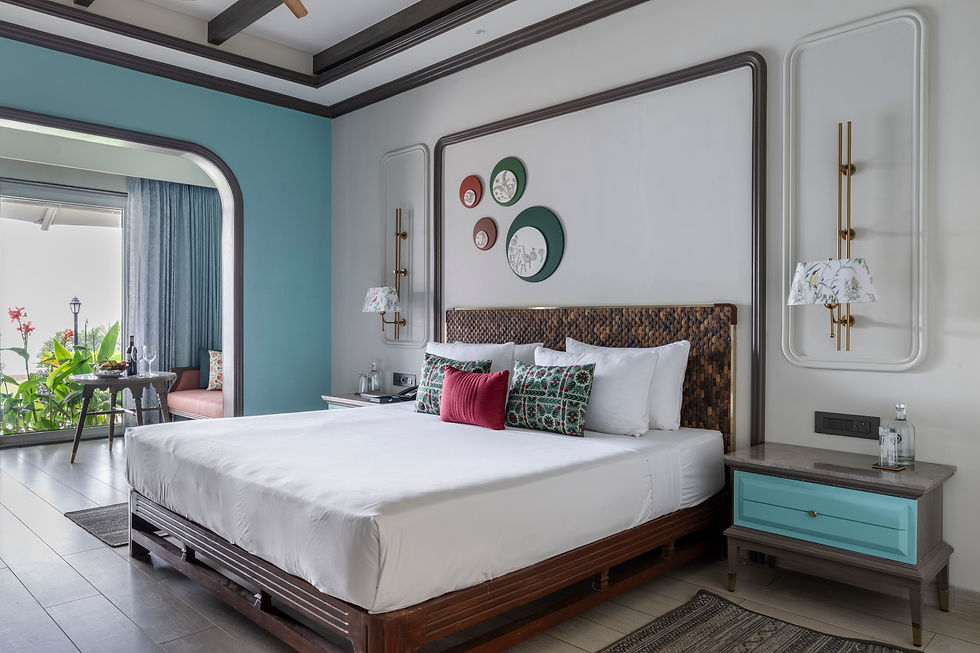
The rooms of the hotel showcase a "bouquet of designs", merging authentic antique furniture, retaining a historical flavour. The planning ensured that rooms were always visually connected to the outdoors. Whether through large windows framing the hills or garden-facing verandahs, every room offered an experience of immersion in nature. Each room varies in age, character, and style to maintain the aged architectural honesty, which gives way to a cohesive as well as diverse experience for the guests. Some rooms are rooted in colonial tradition, others are defined by modern classic expressions, and still others embody contemporary minimalism. This multiplicity isn’t seen as a flaw but as a strength — each room offering a distinct narrative, shaped by the era in which it was built. There are antique beds that are over a century old, refinished and reframed in updated suites. Some pieces were retained in their original form, others restored and carefully integrated. The focus was on quiet luxury, where entertainment came not from devices but from the drama of the landscape.

The Presidential Suite features a plunge pool with panoramic views, making it a sought-after space for guests wanting a secluded and quiet luxury. The design didn’t aim to create a single aesthetic thread across the resort, but rather allowed every building to speak in its own voice — an honest reflection of the layered history of the site. Another striking feature of the hotel is that it houses one of the largest banquet spaces in the hill station, with luscious, expansive lawns. Other amenities include adventure sports arenas, recreational amenities, and a spa.

Challenges were plenty. The hill station’s climate severely limits working days — winters are too cold, and monsoons too wet — leaving only about eight viable construction months in a year. Transporting materials up the hills, protecting completed work from moisture, and maintaining consistency across old and new blocks tested the team’s patience and precision. But the result is a resort that isn’t frozen in time, nor detached from it. It is a continuum — where stories, architecture, memories, and nature coalesce into an experience that feels both deeply familiar and refreshingly new.
The Fountain SeleQtion is not just a resort but a layered narrative of Mahabaleshwar and the property's history. Each space, each room holds a story, offering guests an emotionally immersive experience. It invites not just guests, but generations to return and rediscover what it means to belong to a place.


Comments